Nothing kills a great living room setup faster than a sofa cushion that goes completely flat after six months. When you’re buying a modular couch, the fabric gets all the attention—but it’s what’s stuffed inside that dictates whether it stays supportive or turns into a lumpy mess. Whether you're looking for cloud-like softness or need a high-density, durable modular sectional sofa that stands up to kids and pets, this sofa filling guide breaks down how high-resilience foam, down-blend cushion inserts, and polyfill actually perform in real homes over time.
5 Common Types of Sofa Cushion Fillings & Inserts
1. High-Resilience (HR) Foam
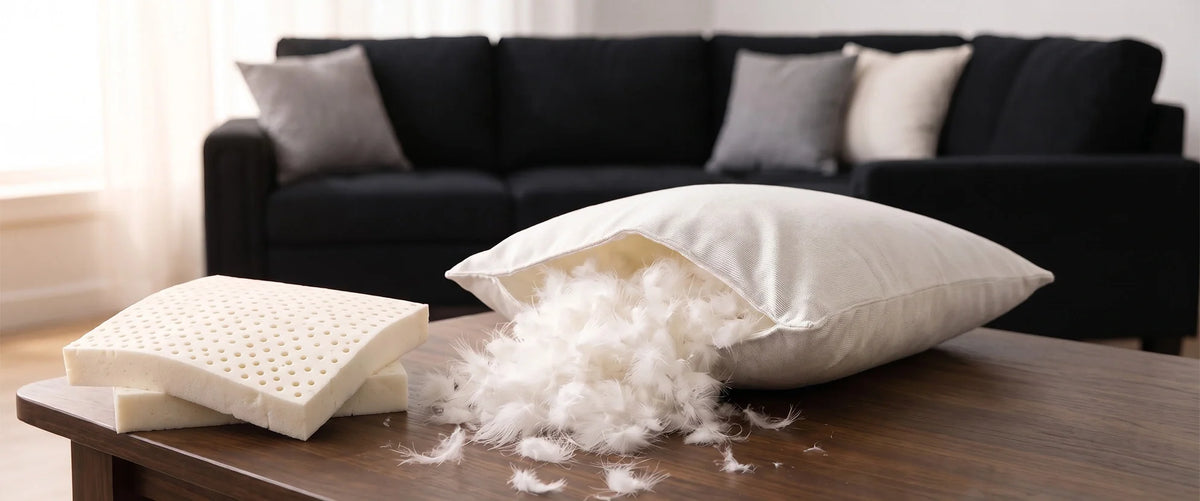
If you want modular sofa cushions that don't sag without feeling like a wooden bench, High-Resilience (HR) foam is the gold standard. Unlike cheap, low-density foam that sags into a ditch within two years, quality HR foam is rated at 1.8 to 2.5 lbs / cu. ft., with an ILD (Indentation Load Deflection) rating around 30–35 for balanced firmness.
The Real Experience: It offers a responsive, slightly buoyant sit. You won't sink in too deep, but you also won't wake up with lower back strain.
The Caveat: Cheaper "high-density" foams are often stiff out of the box and break down rapidly. Check the spec sheet: if the cushion foam density is under 1.8 lbs, pass on it.
Best For: High-traffic living rooms, families with kids, and anyone looking for a low-maintenance sofa cushion.

2. Down & Feather Blends
Nothing beats the cloud-like feeling of genuine down and feathers. However, a 100% down cushion quickly turns into an unstructured mess, so manufacturers almost always use down-blend cushion inserts—a high-density core wrapped in a feather down wrap (typically 80% feathers for structure, 20% down for softness) inside a channel-stitched casing.
The Real Experience: It gives you that high-end, relaxed "drape" look and deep, firm-vs.-plush sofa cushion versatility.
The Caveat: It is high-maintenance. You will need to flip and fluff these cushions daily to prevent them from staying flattened. Also, stray quill ends can occasionally poke through standard fabrics.
Best For: Formal living rooms, cozy reading nooks, and loungers who love a soft, enveloping sink-in feel.

3. Memory Foam
Memory foam (viscoelastic foam) reacts to your body heat and weight, contouring tightly around your hips and spine. While incredible for mattresses, a 100% memory foam cushion is a bad idea—it creates a "stuck" feeling that makes getting up surprisingly awkward.
The Real Experience: High-end modular sectional couches use memory foam as a 1- to 2-inch top layer over a dense high-resilience foam base. This gives you contouring pressure relief without sinking to the wooden frame.
The Caveat: Cheap memory foam traps body heat and gets stiff in cold rooms. Look for gel-infused or open-cell memory foam to avoid overheating during movie night.
Best For: People seeking the best modular sectional sofa filling for back pain, joint pressure relief, or long reclining sessions.

4. Natural Latex
Derived from rubber tree sap, a natural latex cushion insert is the most durable filling on the market, easily lasting 10–15 years without losing elasticity.
The Real Experience: Latex doesn't feel like memory foam. Instead of a slow sink, it has an immediate "bounce back" that supports your weight evenly while keeping your spine aligned.
The Caveat: It is heavy, noticeably expensive, and can feel overly springy if you prefer a plush seat. Always ensure it's certified natural latex (like GOLS) rather than synthetic petroleum-based latex.
Best For: Eco-conscious buyers, allergy sufferers (naturally dust-mite resistant), and long-term durability.

5. Polyester Fiber (Polyfill)
Polyester fiberfill (often blown polyester fiberfill/polyfill) is the most budget-friendly option. It’s lightweight, hypoallergenic, and gives a soft initial feel.
The Real Experience: Out of the box, polyfill cushions look plump and inviting. But because fibers lack cell structure, they compress and mat down under body weight.
The Caveat: Within 12–18 months, loose polyfill tends to clump and sag. A popular industry fix is a Dacron-wrapped foam core—wrapping a poly-fiber layer around a firm foam block to achieve a plush surface with structural longevity.
Best For: Budget-conscious shoppers, accent chairs, or decorative back pillows rather than main seat cushions.
Sofa Cushion Filling Types: Quick Comparison Guide
| Filling Type | Pros | Feel / Support | Lifespan & Maint. | Ideal For |
| High-Resilience (HR) Foam | • Long-lasting shape retention | Medium-firm to firm; springy, buoyant support | 8–12+ years | Daily living rooms, busy families, long-term durability |
| • Excellent ergonomic support | Maintenance: None | |||
| • Zero daily maintenance | ||||
| Down & Feather Blends | • Luxurious, cloud-like comfort | Ultra-soft; deep "sink-in" wrap-around feel | 5–10 years | Lounging, formal living spaces, softness lovers |
| • Highly customizable & cozy | Maintenance: Daily fluffing & flipping | |||
| • Premium aesthetic | ||||
| Memory Foam | • Exceptional pressure relief | Slow-rebound contouring; best paired as a top layer | 6–8 years | People with back/joint pain, long movie nights |
| • Contours to body shape | Maintenance: Low | |||
| • Great for joint pain | ||||
| Natural Latex | • Eco-friendly & non-toxic | Firm yet bouncy; active weight distribution | 10–15+ years | Eco-conscious buyers, allergy sufferers, durability |
| • Highly durable & resilient | Maintenance: Minimal | |||
| • Naturally dust-mite resistant | ||||
| Polyester Fiber (Polyfill) | • Budget-friendly | Soft initial feel, but bottoms out easily | 1–3 years | Guest rooms, accent chairs, tight budget |
| • Lightweight & hypoallergenic | Maintenance: Frequent shaking/fluffing | |||
| • Soft initial feel |
What to Consider Before Buying
Picking the right cushion inserts isn't just about how a modular sectional couch feels during a 30-second showroom test. It’s about performance after two years of dog jumps, movie marathons, and daily wear. Here are the real-world factors to weigh:
1. Household Lifestyle & Usage Intensity
If your modular couch doubles as a trampoline or pet bed, steer clear of pure down or low-density polyfill. You need a high-resilience foam core or natural latex that bounces back instantly.
2. Maintenance
Be honest about how much effort you want to put into maintenance. High-resilience foam and latex hold their shape independently—set them and forget them. Down blends require daily punching, fluffing, and flipping to prevent a flattened look.
3. Body Type & Physical Ergonomics
Heavyweight / Tall Individuals: Low-grade foam or pure fiber will lead to sofa cushions bottoming out (where your hips sink straight to the wooden frame). Opt for a firm sofa foam density of 1.8–2.5 lbs/cu. ft., wrapped in a Dacron layer.
Lower Back or Joint Pain: Avoid unstructured cushions that cause spinal slumping. A supportive latex core or a pocket spring modular sectional sofa cushion wrapped in foam keeps your spine in neutral alignment.
The Comfortable Sofa Reviews
1. Marea Water-Resistant Chenille Down Modular Sofa

If you’re looking for that sought-after "cloud-like" sink-in comfort without sacrificing everyday durability, the Marea is the ultimate spill-resistant / water-resistant modular sofa.
Instead of relying on a single material, the Marea Water-Resistant Chenille Down Modular Sofa uses a hybrid cushion construction: a high-resiliency foam core wrapped in a plush feather-and-down layer inside a down-proof casing. This hybrid build delivers the immediate softness of a down-blend cushion insert while the foam inner core prevents the seat from bottoming out after long lounging sessions.
Perfect for families and pet owners who love a soft, plush aesthetic but need low-stress fabric protection and long-lasting core support.
2. Elora Modular Sofa

If your main priorities are long-term shape retention, active lumbar support sofa design, and zero-maintenance durability, the Elora Modular Sofa is a best sectional for heavy everyday use.
Unlike traditional modular couches that rely solely on solid foam blocks, the Elora utilizes a hybrid pocket spring sofa cushion system surrounded by a high-resilience foam core. This mattress-grade technology allows individual steel coils to respond to your body weight, while high-density foam cushions pressure points and prevents sagging.
The ideal choice for high-traffic family rooms, gamers, and anyone who wants a supportive, durable modular sectional sofa that maintains its tailored structure for years without fluffing.
3. Avelia Oversized Cloud Modular Sofa

If you want the iconic deep-seat oversized cloud modular couch look—but need a frame that holds up when the whole family piles on—the Avelia delivers big-scale comfort with serious core integrity.
Many oversized cloud couches rely on cheap fiberfill that flattens into a pancake. The Avelia Oversized Cloud Modular Sofa avoids this by pairing an extra-deep seat profile with a heavy-duty high-density support foam core. This foundation absorbs heavy weight without letting you sink to the frame, making it a top choice when searching for how to fix saggy sofa cushions once and for all by buying right the first time.
The ultimate match for large living spaces, tall individuals, and avid movie loungers who want deep, cloud-like relaxation backed by high-density structural support.
Which Sofa Filling Should You Choose?
There is no single "best" sofa cushion filling—only the one that matches your daily routine, comfort preferences, and willingness to maintain it.
To make your final decision straightforward, use this quick checklist:
Go with High-Resilience Foam or Pocket Springs if: You want a clean, tailored look with crisp lumbar support, zero daily fluffing, and modular sectional sofa cushions that don't sag under heavy daily traffic.
Go with a Down & Feather Hybrid if: You love luxurious, sink-in "cloud-like" softness for cozy evening lounging and don't mind quick daily fluffing—especially if you want spill-resistant fabric protection to safeguard the down core.
Go with an Oversized High-Density Foam Core if: You have a spacious living area, love extra-deep seating to stretch out, and need heavy-duty structural support that won’t bottom out over time.
Go with Polyfill if: You're working with a tight budget or buying an accent chair for a low-traffic guest room where daily long-term durability isn't a primary concern.
Love the Comfort of Your Living Room? Experience It in the Bedroom.
If you appreciate the ergonomic support and plush design of our modular sofas, you’ll love what we’ve built for your sleep. We’ve expanded our focus on everyday comfort to help you create the ultimate bedroom sanctuary.
Explore our new collection of supportive, noise-free, and easy-assembly bed frames at Belffinsleep—crafted with the same commitment to quality, style, and long-lasting durability.
👉 Shop Belffinsleep Bed Frames & Upgrade Your Sleep
FAQs
How often do you need to fluff down sofa cushions?
Down modular sectional sofa cushions should be fluffed and rotated at least 2 to 3 times a week, or daily for high-use sofas. Unlike foam, down lacks an internal cellular structure and relies on air pockets between feathers for loft. If you leave down cushions un-fluffed, body weight compacts the feathers, causing permanent flattening. For zero-maintenance seating, opt for high-resilience foam instead.
What is the minimum foam density for a sofa cushion that won't sag?
A sofa seat cushion should have a minimum cushion foam density of 1.8 lbs/cu. ft. for average home use, and 2.0 to 2.5 lbs/cu. ft. for heavy daily use. Density dictates longevity, not firmness. Low-density foam (under 1.8 lbs) breaks down within 12–18 months, whereas high-density foam maintains its structural integrity for 8 to 12+ years.
Can you combine different filling materials in one sofa cushion?
Yes, hybrid cushions are the industry standard for balancing soft comfort with structural support. The most durable configuration is a high-resilience foam core or pocket spring modular sofa cushion wrapped in a top layer of down-blend cushion inserts (80% feathers / 20% down) or a Dacron-wrapped foam core. This hybrid build provides a plush initial feel while preventing the cushion from bottoming out against the frame.
What sofa filling is best for people with lower back pain?
High-resilience foam or pocket spring sofa cushion cores are the best sofa fillings for back pain because they keep the lumbar spine in neutral alignment. Ultra-soft fillings like pure down or loose polyfill allow your hips to sink too deep, forcing the lower back into a slouched position that worsens spinal strain. Look for cushions with an ILD rating between 28 and 35 for optimal pressure relief and ergonomic support.