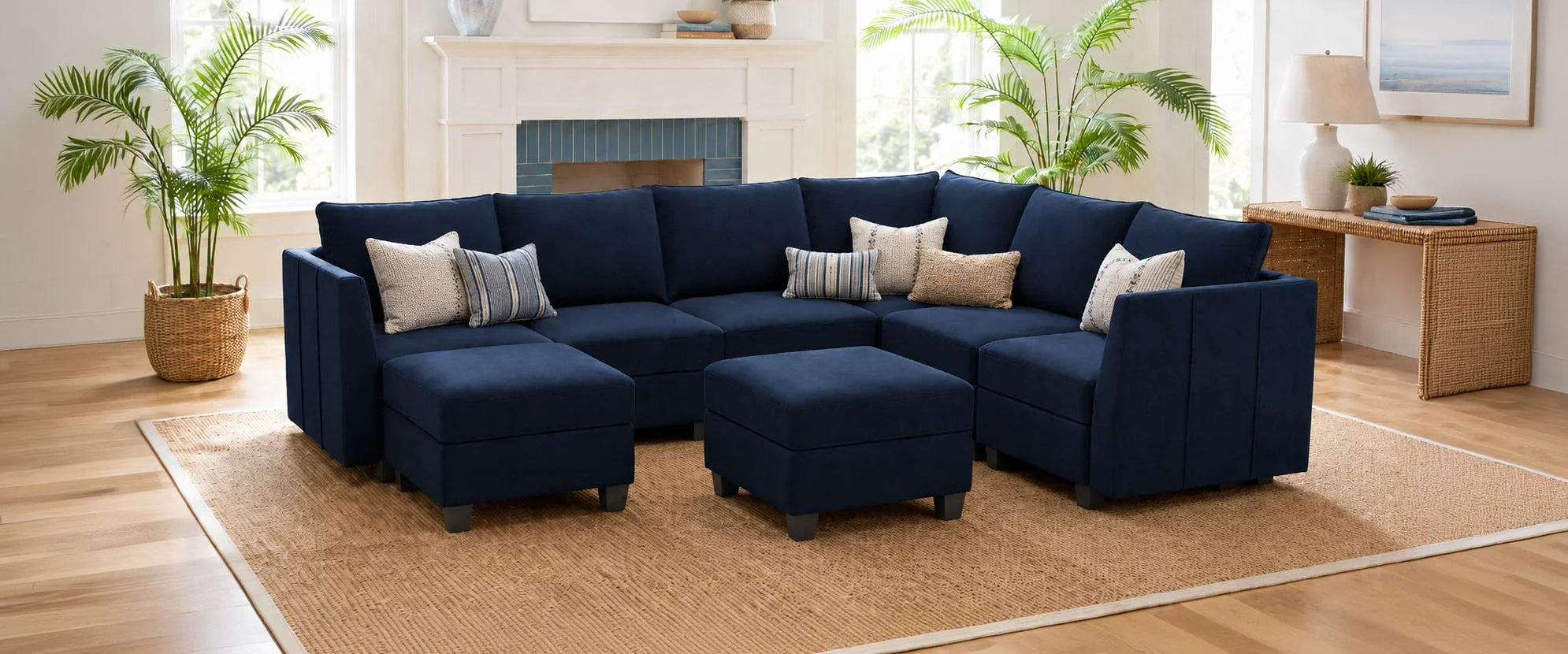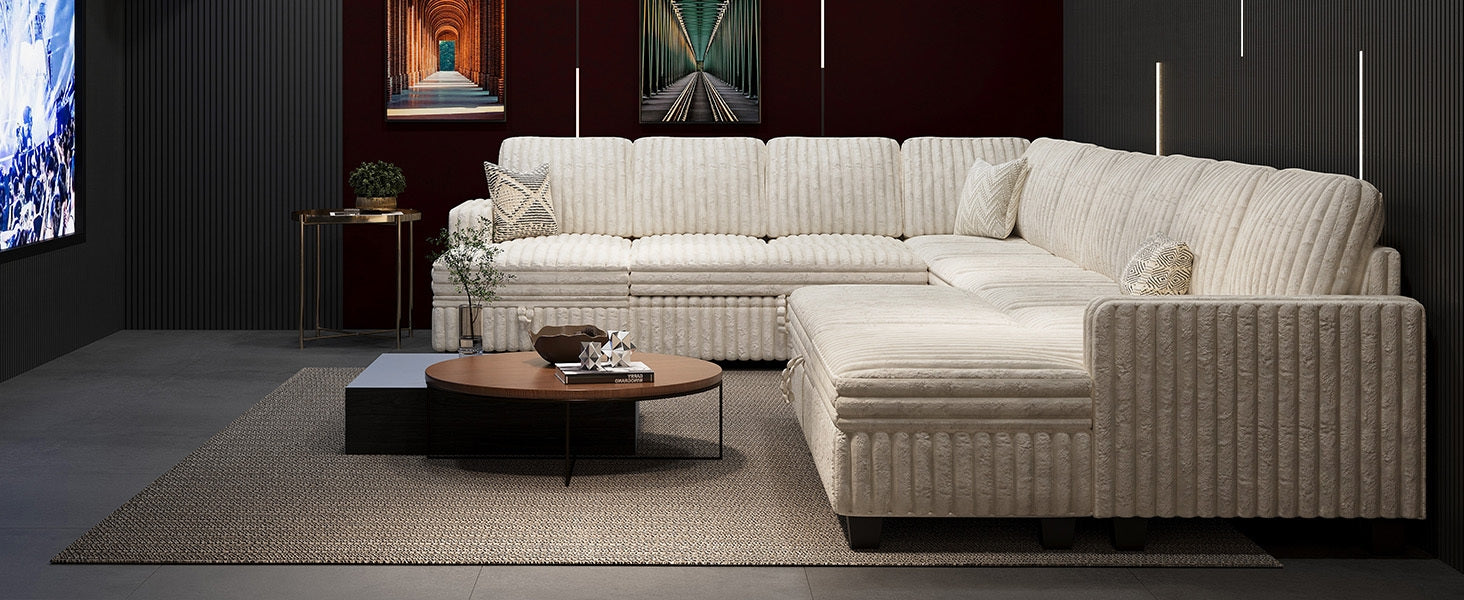

You decide to give your living room a makeover. Perhaps your old sofa is sagging, requiring a struggle to climb out every time you sit down; or maybe you've finally moved into your dream home, gazing at the empty living room with anticipation. You open your phone, ready to shop for that piece of furniture you've been eyeing for so long—the modular couch.
However, the numbers on the screen instantly cast doubt: on one side, a minimalist modular sectional is priced at a whopping $8888; on the other, a Scandinavian-style modular sofa is only $399.
Why such a huge price difference for sofas?
This "price shock" is a painful experience for every furniture buyer. As the most frequently used and largest piece of furniture in the living room, the sofa not only determines the aesthetic level of your home but also your happiness during those few hours after getting off work. Should you buy a cheap one to "make do" for now, or invest heavily in a classic piece that can be passed down to the next generation?
In this guide, we'll clear the fog surrounding the modular sofa market in 2026. We're going to talk about the "hidden technology" behind those expensive labels, dissect the true value of different price ranges, and teach you how to find the perfect balance between budget, comfort, and durability. Don't let price tags scare away your comfortable life; let's see how much a sofa is really worth.
Entry-Level Couch: $300-$600
In the lower price range, you'll find many affordable sectional couches available online or in chain stores. These typically feature composite wood frames (particleboard or plywood) and medium- to low-density foam. The fabric is often polyester. While affordable, these sofas have a lifespan of only 1-3 years. If you plan to live in them long-term, the cushions may start to sag after a year.
Common Features:
Demountable design;
Composite material frame;
Medium- to low-density foam with "sandwich" filling;
Polyester fabric (synthetic fiber fabric)
Mid-Range Couch: $700 to $1500
This is the top choice for many "new middle-class" families or owners of fully furnished homes. At this price point, you're not just buying a "place to sit," but paying for support, advanced fabric technology, and up to 10 years of companionship. The structure has been upgraded from simple timber to a kiln-dried solid wood frame (moisture-proof and crack-resistant), and the filling now includes individual springs. The seating experience is no longer simply hard or soft but offers layered support.
In this price range, you'll have a wider selection of sofa types, including three-seater sofas, compact sectional sofas, and modern minimalist sofas. You can find truly high-performance fabrics, such as premium cat-scratch fabric (durable and abrasion-resistant), highly stain-resistant technical fabrics, or entry-level semi-leather.
You can expect:
Durable high-performance fabrics
High-density foam and individual springs
Enhanced comfort and structure
High-End Couch: $1600 to $5000+
In 2026, the definition of a high-end sofa has transcended mere seating; it represents scarce materials, masterful design, and almost obsessive craftsmanship. Full-grain A+ grade cowhide (typically over 2mm thick), a solid black walnut wood frame, and filling with abundant white goose down are common features of high-end sofas.
This type of sofa provides a "sitting" sensation the moment you sit down, and the frame support guarantees stability for 20 years. If you value both performance and aesthetics, a high-end sofa is often a wise long-term investment.
Highlights include:
Premium fabrics
Handcrafted craftsmanship
Tool-free assembly
Enhanced lumbar or ergonomic support

How Does Sofa Type Change the Price?
Sofa type is another key factor determining price. Even with the same materials, different shapes and functions can lead to significant cost variations.
1. Loveseat / 3-Seater
This is the most basic and cost-effective type.
Price Impact: It serves as the market benchmark. Due to its symmetrical structure and simple load-bearing capacity, this style has the lowest premium.
Saving Tip: If you have a limited budget, buying a high-quality three-seater sofa and pairing it with an inexpensive armchair often creates a more sophisticated look than buying a cheap sectional sofa set.
2. Sectional Sofa / L-Shaped Sofa
Once the word "sectional" is involved, the price usually increases by 30% - 70% compared to a standard three-seater.
Price Impact: Complex Structure: L-shaped corner sofas (chaise lounges) require independent frame support and more fabric.
Connecting Hardware Costs: The hardware used to connect different modules also incurs costs.
Highlights: Suitable for large living rooms, providing more space for lounging, but it takes up a lot of space and offers relatively low flexibility.
3. Sleeper Sofa
Don't assume a sofa bed is a "buy one get one free" deal; it's often more expensive than a comparable regular sofa.
Price Impact: Internal Mechanism: The folding mechanism or pull-out rails must be sturdy enough to support the weight of two people sleeping in it.
Dual Structure: You're buying both a sofa frame and a folding bed frame.
Pain Points: Cheap sleeper sofas are often too hard as a sofa and too soft as a bed. To achieve the best of both worlds, your budget usually needs to be mid-range.
4. Modular Sofa
Composed of multiple independent blocks, it can be assembled like Lego bricks.
Price Impact: Usually more expensive than a fully assembled sofa.
Because each module (armrests, center section, corner sections) must be fully upholstered and have an independent structure, unlike fully assembled sofas, which share frames and fabrics, resulting in higher wear and tear.
Advantages: Extremely convenient to move, and can be freely combined to suit different room layouts.
A High-Quality Sofa Worth Investing In
If you're looking for a comfortable and practical sofa without breaking the bank, consider the Belffin Thara modular couch. This modular sofa features a new cat-scratch-resistant fabric, clean lines, and a combination of comfort and durability. The cat-scratch-resistant fabric and sturdy, solid wood frame make it ideal for busy families or those who want to easily customize their space.

Create a Cohesive Look Across Every Room
Interior design doesn’t stop at the living room. Match your aesthetic from the couch to the bed with our sleek, stylish upholstered bed frames at Belffinsleep. Bring timeless minimalism and cloud-like comfort into your master bedroom.
👉 Design Your Dream Bedroom with Belffinsleep
FAQs
How much does a good couch actually cost in 2026?
Couch prices generally fall into three distinct ranges based on materials and expected lifespan:
Entry-Level ($300–$600): Budget-friendly options usually built with composite wood frames and low-to-medium-density foam. They work well for short-term housing or dorms, with a typical lifespan of 1 to 3 years.
Mid-Range ($700–$1,500): The sweet spot for most homes. These feature kiln-dried solid wood frames, high-density foam, or pocket coils, and high-performance stain- or scratch-resistant fabrics. Expect them to last 5 to 10 years.
High-End ($1,600–$5,000+): Premium builds made with solid hardwood (like black walnut), top-grain leather or down-feather fillings, and custom ergonomic designs built to last 15+ years.
Why are modular sectionals usually more expensive than traditional 3-seater couches?
Modular sectionals cost more because each module (corner pieces, armrests, ottomans) is fully upholstered and constructed as an independent, load-bearing unit. Unlike standard sofas that share a single frame and fabric casing, modular units require significantly more raw materials, structural hardware, and labor to produce. In exchange, they offer long-term flexibility, allowing you to reconfigure the layout or easily replace individual sections as your living space changes.
What materials prevent a couch from sagging or deteriorating after a year or two?
To ensure long-term durability, focus on three critical construction details:
Frame: Look for kiln-dried solid wood over particleboard or standard plywood, as it resists warping and cracking.
Support & Filling: High-density foam (at least 1.8 lb/cu. ft.) combined with pocket coils or S-springs provides lasting resiliency without flattening out.
Fabric: High-performance technical fabrics—such as pet-friendly scratch-resistant or high-rub-count polyesters—stand up to daily wear and accidental spills far better than basic synthetic covers.
Is it better to buy a cheap couch and replace it often, or invest in a mid-range model?
For temporary living situations (1–2 years), an entry-level couch under $600 makes practical sense. However, if you plan to stay in your home longer, a mid-range couch ($700–$1,500) offers significantly better long-term value. Replacing a cheap couch every 2 years quickly adds up in both cost and disposal hassle, whereas a well-built mid-range sofa maintains its shape, support, and appearance over many years of continuous use.